The Cottages Lots: The Subdivision Right That Never Gets Used
September 3, 2026
September 3, 2026
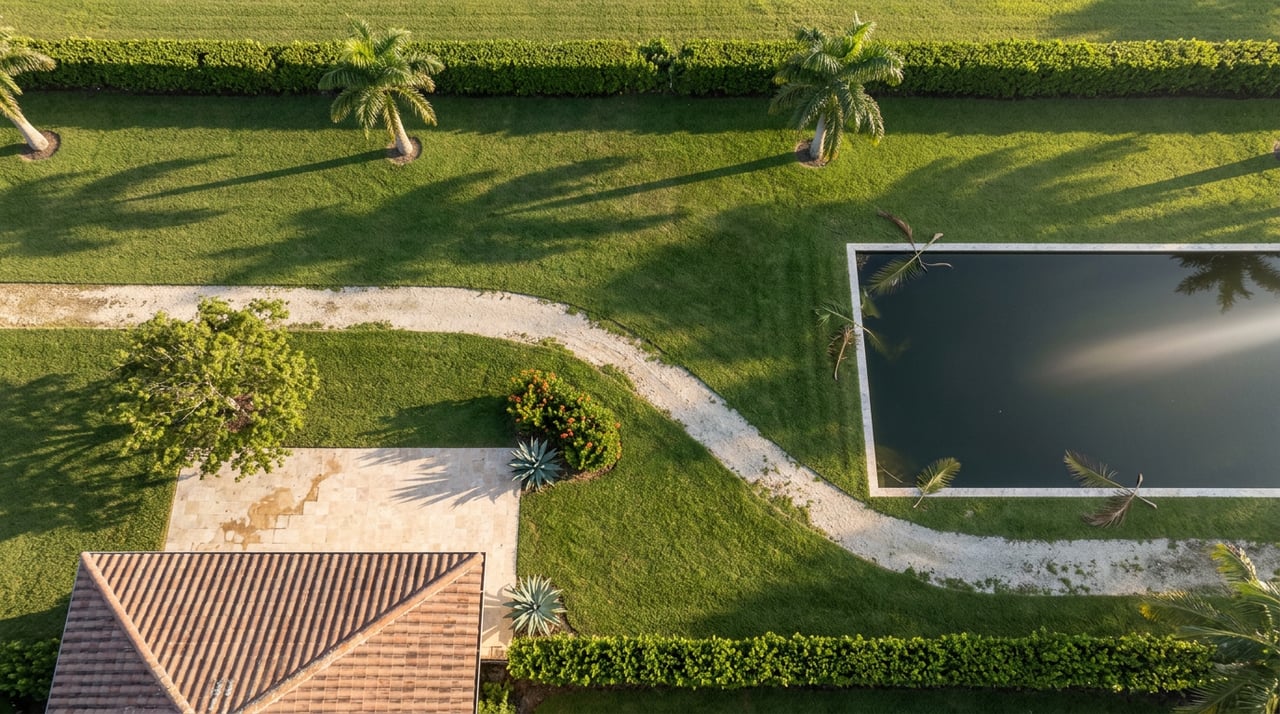
Somewhere off Road 693, past the resort's second gate, public listing records trace one parcel's marketing language back to August 2021, and the pitch has barely changed across the syndicated copies still circulating today: a 3-acre parcel on Laguna Mata Redonda, a home designed by architect Thomas Marvel and built in 1986, remodeled in 2017, set beside a private lake. Near the top of nearly every version, one line repeats: the lot can be segregated into two additional independent properties.
That is an unusually long run for a headline feature to sit untested by an actual buyer. Whatever the property's exact status today, years of identical marketing copy built around a right nobody appears to have exercised is itself worth examining, and it's the real story behind The Cottages Lots, a Dorado Beach micro-market that gets confused with a very different neighborhood carrying almost the same name.
The Cottages Lots sit on land that is HOA independent, meaning owners here answer to no community association and pay no association dues. Marketed alongside that independence is a subdivision right: this specific 3-acre estate could, in theory, be split into three separate parcels, each buildable on its own.
On a spec sheet, that reads as pure upside. In practice, at this price point, the public record shows no sign it has ever been exercised. Subdividing a lakefront lot inside one of Puerto Rico's most exclusive resort footprints means running new utility lines, cutting new access, and finding buyers willing to purchase a lot next door to a $30 million estate rather than the estate itself. None of that is free, and none of it happens automatically because a listing says it's allowed.
A subdivision right only creates value when someone actually wants to subdivide. In a resort built around privacy, most buyers are trying to acquire more of it, not manufacture two new neighbors.
That is the mechanism worth understanding before treating "segregable" as a number that adds to price. It's a legal allowance, not a guaranteed return.
Search "Cottages Dorado Beach" and two unrelated products show up under nearly the same name. One is this HOA-independent lot and estate model near Mata Redonda. The other is a tight 13-to-14 villa compound closer to the beach, built around a shared backup generator and cistern that all owners draw from.
They could not be more different as ownership structures.
| Cottages Lots (Mata Redonda) | The Cottages villa compound | |
|---|---|---|
| Ownership structure | Individual HOA-independent lot or estate | Shared compound of 13 to 14 units |
| Infrastructure | Self-provisioned utilities | Shared backup generator and cistern |
| Monthly fee | Low, no HOA | Shared compound costs |
| Land optionality | Segregable into up to three total properties | Fixed footprint, no subdivision |
| What you're actually buying | Land, privacy, and self-sufficiency | Turnkey access to a small beachfront villa |
A buyer who wants a compact, low-maintenance foothold near the water and doesn't mind sharing infrastructure with a dozen neighbors is shopping in a different market than a buyer evaluating three raw acres on a lagoon. Both carry the Cottages name. Neither is a substitute for the other.
The low monthly fee attached to Cottages Lots reads as a clean advantage over gated Dorado Beach communities that carry association dues for shared amenities and staffed security. What that fee comparison leaves out is what the HOA would have been doing for you.
In the villa compound down the road, a shared generator and cistern mean owners split the cost, maintenance, and planning of backup power and water storage, both essential in a market where storm resilience is part of daily consideration. On an HOA-independent lot, that responsibility doesn't disappear. It just moves from a shared line item to a private one. The owner provisions their own generator, their own water storage, and often their own arrangement for shared road access with neighboring parcels, since there's no association coordinating any of it.
A lower monthly fee is real. So is the fact that it reflects the absence of shared infrastructure, not just the absence of a bill.
The same Mata Redonda lot listing points to its location near what it calls the resort's newest development, a small enclave of only seven homes now under construction along the same lagoon. That proximity cuts two ways for an older, self-provisioned parcel trying to justify its price against newer, purpose-built product going up within sight of it.
On one hand, new construction nearby signals continued demand for lakefront living in this specific pocket of the resort. On the other, a buyer cross-shopping the area now has a turnkey option a short walk away that removes every question this piece has raised. No self-provisioned generator to plan for. No segregation math to underwrite. Just a finished home in a newly built enclave.
That comparison raises the bar for what an unbuilt or self-run Mata Redonda lot has to prove before a buyer chooses it over the finished alternative next door.
Before a subdivision right factors into how you value a lot like this, three things are worth modeling rather than assuming.
First, the real cost of extending utilities and access to create a genuinely independent second or third parcel, not the theoretical cost, since lakefront and resort-adjacent land often carries permitting and infrastructure requirements beyond a standard residential lot.
Second, the actual depth of buyers who want a raw sub-lot at this price tier rather than a finished trophy home. In a market where the top of the range is defined by turnkey estates and branded residences, the buyer pool for a standalone parcel next to someone else's $30 million house is genuinely thin.
Third, the holding cost of an unusually long marketing period. A property that has carried the same pitch since 2021 has also carried years of holding costs while that pitch went untested by an actual buyer.
None of that means HOA-independent land or subdivision rights are a poor bet. It means the right belongs in the conversation as a fact to underwrite, not a number to add to the asking price by default.
Does every property called "The Cottages" in Dorado come with subdivision rights? No. That language applies specifically to certain HOA-independent lots and estates near Mata Redonda. The separate 13-to-14 villa compound near the beach has a fixed footprint and shares infrastructure among owners. The names overlap. The ownership structures don't.
Is a low HOA fee automatically a savings? Only if you compare it against what the fee would have covered. An HOA-independent lot's lower fee often reflects the absence of shared generator, water, and road maintenance arrangements, responsibilities the owner takes on individually instead.
Why has the flagship Mata Redonda lot been listed so long? The most likely explanation is a mismatch between a genuinely rare feature, a segregable, private-lake lot inside Dorado Beach, and a thin pool of buyers who want raw land with self-provisioned infrastructure at this price point rather than a finished estate.
If you're weighing land against turnkey product anywhere in Dorado Beach and want help underwriting what a right on paper is actually worth, Island & Key works these micro-markets daily and can walk through the real numbers with you. Search properties to see what's currently available across Dorado's communities.
Stay up to date on the latest real estate trends.

Where to Find Your Stretch of Sand on the North Coast.
Remodeling and Revamping Your Dorado Home to Match Coastal Island Living.
Your Step-by-Step Guide to Confidently Selling Your Home in Dorado.

Decor Ideas That Bring Out the Best in Dorado Real Estate.

Smart Steps for a Smooth Renovation.